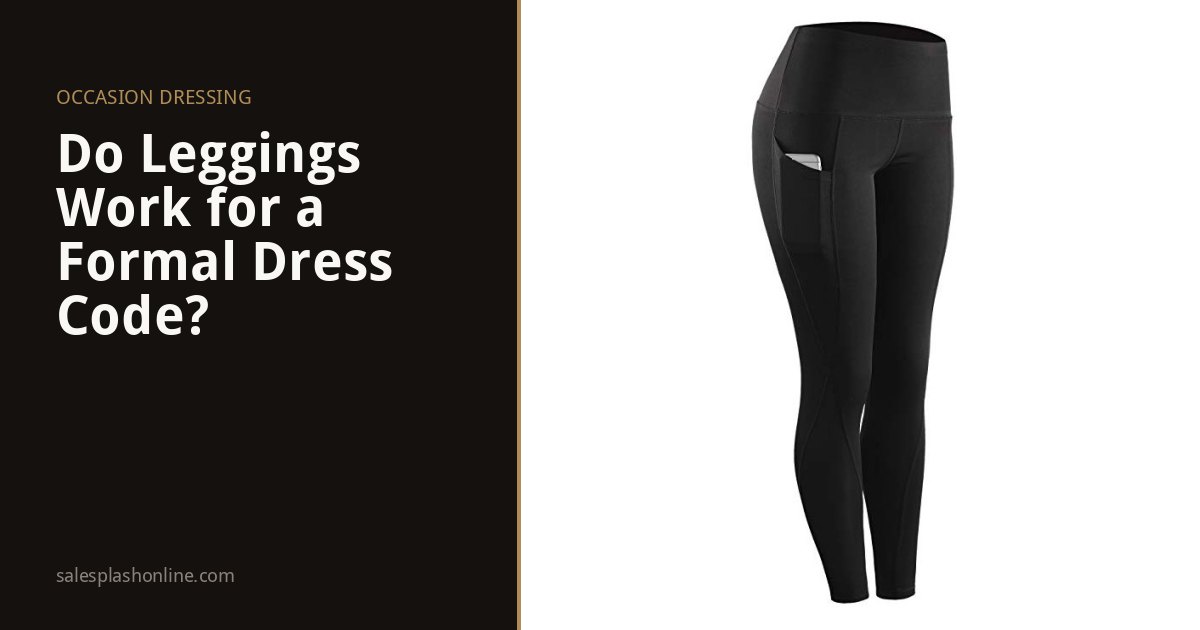
The short answer is usually no, and it is worth being straightforward about that rather than selling you something that will make you uncomfortable in the room. But “formal” covers a very wide range of expectations, and there are specific cases where close-fitting legwear is genuinely fine. Here is where the line actually falls.
What the dress codes actually ask for
Most stated dress codes are about formality of fabric and construction, not about how much leg is covered. That is the key to the whole question.
- Black tie. Floor-length or formal cocktail. Legwear is not appropriate, and no styling changes that. This is the one unambiguous case.
- Cocktail. Structured, evening fabrics. A tailored trouser is acceptable at most cocktail events; a legging is not, though a heavy matte flared trouser sits in a grey area that often passes.
- Business formal. Tailoring. Leggings are outside the code, but the reason is construction rather than fit — a close-cut tailored trouser is fine.
- Business casual. This is where it opens up. A heavy matte legging or a ponte-style trouser under a structured blazer reads as acceptable in most offices.
- Smart casual. Legwear is genuinely fine, provided it is not obviously athletic.
The pattern is consistent: as codes relax, the objection to legwear disappears well before the objection to sportswear does.
The real objection is sportswear, not tightness
Tailored trousers can be extremely close-fitting and remain entirely formal. Riding boots and breeches have been formal dress for centuries. What a formal setting objects to is clothing that signals leisure or exercise — and that signal comes from fabric, finish and detailing rather than from silhouette.
This is useful, because it tells you what to change. A performance knit with a slight sheen and a wide sports waistband will never read as formal. A heavy matte knit in a trouser cut, worn with structure on top, very often will.
The four things that decide it
Fabric weight. Thin is the giveaway. A lightweight technical knit is transparent under office lighting, shows every underlying seam, and drapes like sportswear. Heavier knits hold a line and read as trousers. If you can see the weave stretch when you put them on, they are too light for a formal setting.
Finish. Matte reads formal, shine reads athletic. This single distinction resolves most borderline cases.
The waistband. A wide contoured sports waistband is a strong athletic signal. A flat, narrower band that disappears under a top is not. Since almost nobody sees the waistband in a formal setting, wearing a longer top over it genuinely works.
Silhouette below the knee. A skin-tight ankle reads as a legging. A flare, bootcut or straight leg reads as a trouser. This is the most effective change available and the one worth spending money on.
What to wear instead, if the answer is no
For anything at cocktail level or above, the substitution is a flared or wide-leg high-waisted trouser in a heavy matte fabric. It keeps the comfort of an elasticated waist and a knitted fabric while reading unambiguously as tailoring from a distance. Worn with a fitted top tucked in, heels and a structured clutch, it is genuinely formal dressing, and nobody at the event is auditing the waistband construction.
The other reliable route is a skirted or overlay style, where an attached panel covers the hip and thigh. The eye reads the outer layer, and the question does not arise.
Where legwear is straightforwardly fine
Worth listing, because the “no” above is narrower than it sounds:
- Smart casual events and most restaurant dinners.
- Business casual offices, under a structured blazer.
- Daytime events with no stated code.
- Travel to and from a formal event, where you change on arrival.
- Under a long dress or skirt for warmth, which is invisible and always acceptable.
The accessory does the heavy lifting
If you are pushing legwear toward the formal end, the bag and shoes carry the formality. A structured clutch with proper hardware and a heeled shoe will lift a heavy matte trouser considerably further than most people expect — and conversely, trainers and a slouchy bag will drag a genuinely formal outfit back down. Given a fixed budget, the accessories are the better investment.
Dress codes are regional, and the wording is not reliable
One reason this question is hard to answer is that the same phrase means different things in different places and industries. “Smart casual” in a London office and “smart casual” at a Californian tech company are not the same instruction. “Cocktail” at a summer wedding is more relaxed than “cocktail” at a corporate awards dinner. And in much of continental Europe, stated codes tend to be interpreted more strictly than the same words would be in the US.
Where the wording is ambiguous, the reliable move is to look at the venue and the time. Evening events in hotels and private clubs run formal. Daytime events, restaurants and anything at a private home run relaxed. If you still cannot tell, ask the host — it is a normal question and a much better use of five minutes than guessing.
How to test it before you commit
There is a simple check that resolves most borderline cases, and it takes two minutes.
- Photograph yourself in the actual lighting. Not a mirror — a photograph, full length, from a few paces back. Mirrors flatter and, more importantly, you look at a mirror from your own eye level rather than from where other people will see you.
- Use a flash if the event will be photographed. This is the single most revealing test for fabric thinness, and it is far better to discover a problem at home.
- Sit down and stand up. Watch what happens at the knee and the waistband. Fabric that bags at the knee after thirty seconds will look considerably worse after three hours.
- Check it from behind. Obvious, and skipped by almost everyone.
If the photograph reads as trousers, you are fine. If it reads as gym kit, no amount of accessorising will change the answer.
Layering, and the thing that is always acceptable
One case is never in question: legwear worn under something else. A fine legging under a long dress, a midi skirt or a longer tunic is invisible, adds genuine warmth for a winter event, and removes the hosiery decision entirely. For an outdoor autumn wedding or a draughty venue this is simply the practical answer, and nobody is going to see it.
The same logic applies to travel. Wearing comfortable legwear to a formal event and changing on arrival is not a compromise; it is what most people who attend a lot of these events actually do.
What we stock at the dressier end
- High-Waist Flared Yoga Pants — close through hip and thigh, opening into a flare below the knee. The most formal-capable cut we carry.
- Flare Yoga Pants — nylon flare in five earth tones, with enough weight to hold a line.
- Black Cropped Yoga Pants — cropped with a slight flare and a high elastic waist, for business casual.
- Skirted Leggings with Pockets — attached overlay panel, which removes the coverage question.
- Seamless High-Waist Leggings in plain matte black — the right base layer when the top half is doing the formal work.
For the accessories, the evening clutch range includes structured styles suited to formal events, and our guide to what makes a clutch look expensive explains what to look for. Sizing help is in the size guide.
Shop this guide: faux leather leggings · black leggings · evening clutches · gold clutches