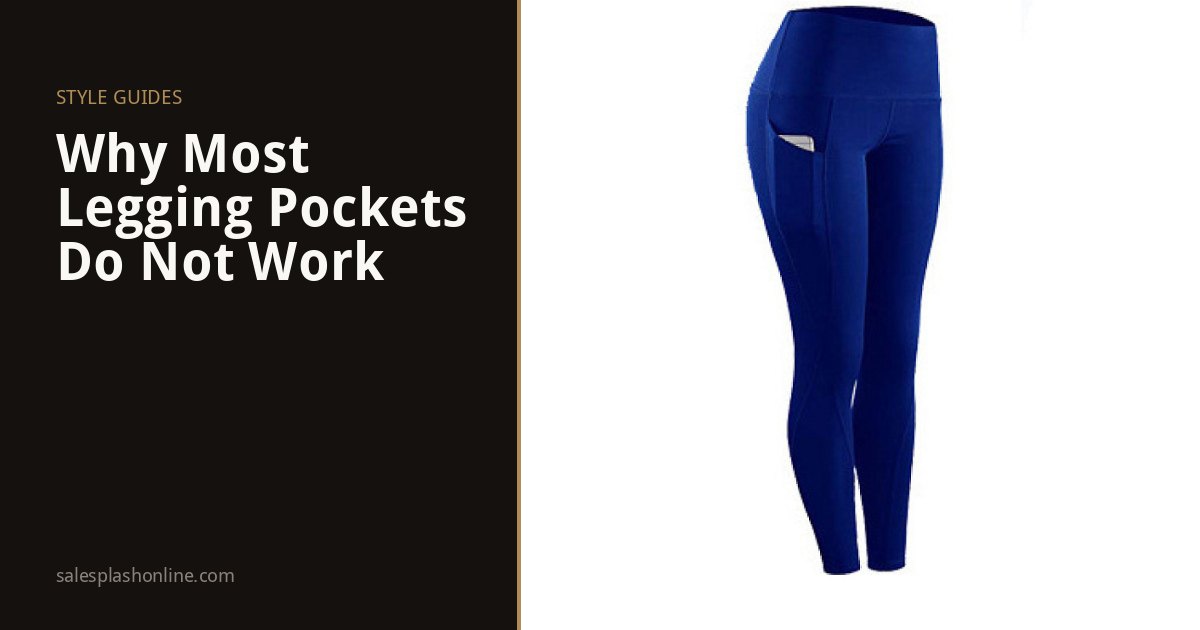
Pockets are now on almost every legging listing, and most of them are close to useless. Not because manufacturers are careless, but because a pocket in a stretch garment is a genuinely difficult engineering problem: you are cutting an opening in a surface whose entire job is to be under even tension. Here is why most fail, and the small number of things that predict one that works.
The problem, stated plainly
A legging works by being uniformly tensioned around the leg. A pocket introduces a discontinuity into that surface, and then asks it to hold a weight. Three consequences follow, and they explain nearly every bad pocket you have used.
The pocket stretches with the fabric. A pocket sized for a phone on the hanger is a larger, looser pocket once the legging is on a body, because the opening stretches along with everything else. This is why phones that fit in the shop slide out during a run.
Weight distorts the fit. A modern phone weighs around 200g. Hung off one side of a tensioned knit, that is enough to drag the waistband down on that side and set up an asymmetric pull through the whole garment. It is also the main cause of waistband roll on pocket styles.
The contents bounce. A pocket in a soft knit has no rigidity, so anything in it swings with your stride. Over a mile that is distracting; over five it is genuinely annoying and it chafes.
Where the pocket sits decides almost everything
- Mid-thigh side pocket. The most common design and the worst performer for anything heavy. It is the point of maximum leg movement, so a phone swings on the longest lever available. Fine for a card and a key; poor for a phone during running.
- High hip pocket. Sits close to the body’s centre of mass, where there is far less movement. A phone here stays much more stable. This is the better engineering answer and it is less common because it is harder to make look elegant.
- Waistband pocket. The most stable position of all, because the waistband is the most heavily tensioned and least mobile part of the garment. Usually small — a card, a key, a gel — but what it does hold, it holds securely.
- Back waistband pocket. Stable and secure, and you cannot see it, which some people dislike and which makes it easy to forget something is in there before washing.
What separates a working pocket from a decorative one
- Depth beyond the phone. A pocket needs several centimetres more depth than the object, so that the phone sits below the opening rather than level with it. A pocket exactly phone-sized will eject the phone the first time you sit down.
- A bound or ribbed opening. The edge needs to be reinforced so it does not stretch open under load. A raw or simply overlocked edge will relax within a few wears.
- An angled or curved opening. An opening cut across the direction of leg movement stays closed better than a straight vertical slit.
- A separate pocket bag, not just a slit. Some cheaper designs are an opening into the space between two layers, which means the phone migrates around the thigh. A properly constructed pocket has its own stitched bag.
- A zip, if you actually need security. A zip solves ejection outright. It costs you a hard component against the leg, so placement matters more — but for anything you genuinely cannot lose, it is the only reliable answer.
How to test one before you commit
Two minutes, in the changing room or at home before removing tags.
- Put your actual phone in it. Not a hand, not a wallet. Phone sizes vary by several centimetres and it is the only test that matters.
- Squat fully. If the phone rises toward the opening or falls out, the pocket is too shallow.
- Walk up stairs. This exposes bounce faster than walking on the flat.
- Check the waistband on that side. If it has dropped after thirty seconds of movement, it will be worse after a mile.
- Sit down. A mid-thigh pocket with a phone in it is uncomfortable when seated, which matters if you wear the leggings to travel.
Matching the pocket to the use
The honest answer is that different activities want different things, and no single pocket design covers all of them.
For running, a phone in a mid-thigh pocket is a poor solution regardless of how well made it is; a high hip or waistband pocket, or a dedicated armband or belt, will be better. For the gym, almost any pocket works, because you are rarely moving continuously with the phone in it. For yoga and pilates, a zip pocket is worth it, because you spend time inverted and gravity is not on your side. For everyday wear and travel, a deep side pocket is genuinely useful, and this is the case where the common design actually shines.
What we stock, and what each is suited to
- High-Waist Pocket Leggings — 14 Colours — side pocket on each leg, quick-dry, XS to XXL. The general-purpose option.
- High-Waist Yoga Leggings with Pockets — a side pocket on each leg, sized to take a phone, to 2XL.
- High-Waist Leggings with Hip Pockets — pockets set into the hip rather than the thigh, which is the more stable position.
- High-Waist Yoga Leggings with Phone Pocket — a dedicated side phone pocket, in black, grey and navy.
- Zip-Pocket Pilates Leggings — a secure zip pocket, the right choice when you cannot afford to lose the contents.
- Mesh-Panel Yoga Leggings with Pockets and Pocket Mesh Yoga Leggings — ventilation plus storage.
- Skirted Leggings with Pockets — a pocket on each side under an attached skirt overlay.
- Double-Layer Running Shorts with Pocket — a side pocket in the shell over a fitted inner liner.
One caveat worth repeating from the fit side: styles with fixed pocket panels have slightly less give through the thigh than a plain knit, so if you are between sizes, lean to the larger. The size guide has the measurements, and the leggings range has everything else.