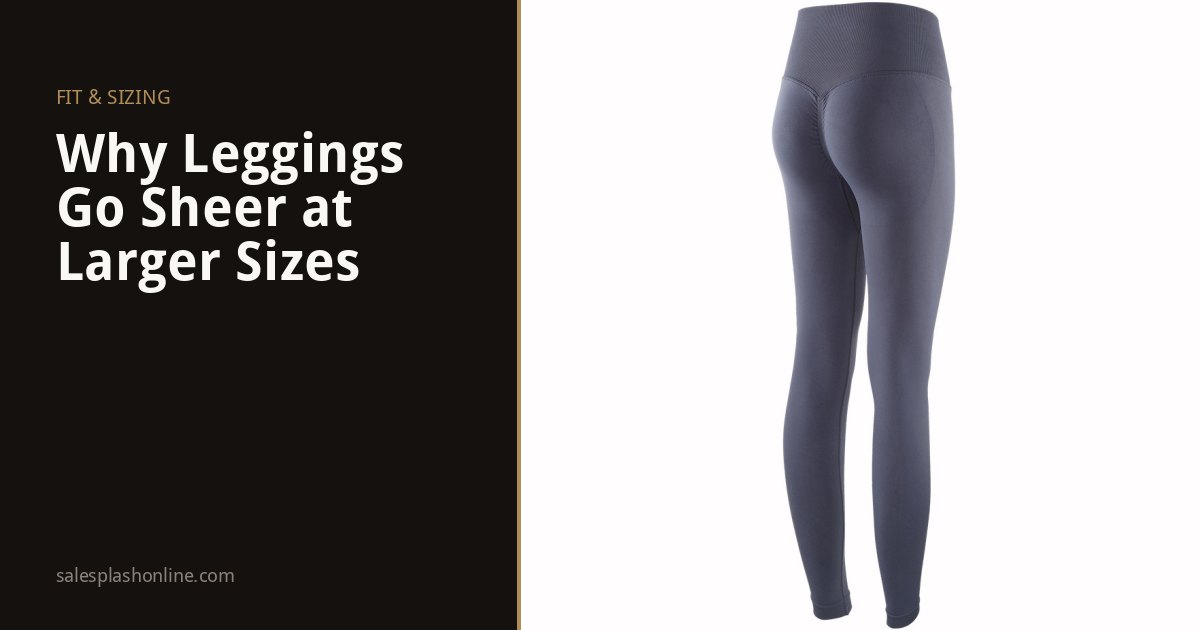
Sheer leggings are usually blamed on poor quality, and sometimes that is fair. But the effect gets noticeably worse as sizes go up, and that pattern is not about quality at all. It is about geometry. Understanding why makes it much easier to buy a pair that will not do it.
The physics, which is simpler than it sounds
A knitted fabric contains a fixed amount of yarn per unit of relaxed fabric. When you stretch it, that same yarn has to cover a larger area, so the gaps between the loops open up and less light is blocked. Stretch it further and the fabric gets thinner and more transparent. That is the whole mechanism.
The consequence for sizing is direct. A given garment is graded up from a base size, but the fabric specification usually stays the same across the run. The larger sizes are therefore asking the identical fabric to cover more area, and they are frequently doing it under more tension. A knit that is comfortably opaque at M can be marginal at XL and visibly sheer at XXL — same fabric, same factory, same quality.
Which is why this is not a fault you did anything to cause, and not usually something a brand is hiding from you. It is a property of stretch fabric that becomes more pronounced the further you sit from the base size.
Where it shows first
Always the seat and the outer thigh, and always under flexion. Standing still, almost anything looks fine. Bending forward puts the fabric across the seat under the greatest tension it will experience, which is exactly the moment other people are behind you.
The outer thigh is the second failure point, because that is where the fabric wraps the widest part of the leg. If you are checking a pair, those two areas are the only ones worth looking at.
Sizing up: sometimes the fix, sometimes not
The usual advice is to buy a size larger, and it is only half right.
Sizing up genuinely helps when the pair you have is too small, because you are reducing the tension on the fabric. That is the common case and the advice works.
It does not help when you are already at the top of a size run. The largest size in a graded set is often made from the same fabric with the same stitch density, so you may simply get a larger garment with identical opacity behaviour. And a legging that is too large brings its own problem: it sags, then gets pulled up and readjusted repeatedly through the day, which puts it under exactly the tension you were trying to avoid.
The reliable version of the advice is narrower: buy your measured size, and choose a denser fabric. Fabric selection does far more work here than size selection.
What actually predicts opacity
- Fabric weight. The most reliable single indicator. Heavier fabric contains more yarn per unit area and stays opaque further into its stretch range. If a legging feels notably light in the hand, it will be marginal under tension.
- Knit density. A tighter stitch has smaller gaps to open. This is why two fabrics of similar weight can behave differently.
- Colour and pigment. Dark yarn blocks more light. Black is the most forgiving colour there is; pale grey, beige, white and pastels are the least, and light heather marls are the worst of all because the yarn itself is a mix of light and dark fibres.
- Texture. Ribbed, jacquard and honeycomb knits put more yarn into the same area and physically vary the surface, which disguises any thinning. Textured styles are consistently more opaque than smooth ones of the same weight.
- Lining. A brushed or fleece lining is a second layer of structure. Lined winter styles are almost always the most opaque things in a range.
The test, done properly
Our squat test covers the basics; here is the version worth doing at the larger end of a size run.
- Do it in bright, direct light — daylight from a window, not a dim bedroom. Backlighting is the harshest and most honest condition.
- Squat fully, do not just bend. A half-bend does not reach the tension a full squat does.
- Have someone look, or photograph it. You cannot assess your own seat in a mirror, and this is the step people skip.
- Use a flash if the leggings will be photographed. Flash finds thinness that daylight does not.
- Wear the underwear you would actually wear. Testing over nothing, or over something dark under dark fabric, tells you nothing useful.
- Do it before you remove tags, so an honest failure is still returnable.
Things that do not work
Worth saying plainly, because these come up often. Washing does not fix sheerness — it slightly relaxes the fibres if anything. Layering a second pair works but is uncomfortable and hot. Wearing them “a few times to break them in” makes it worse, because elastane loses some recovery with wear. And buying the same style in a darker colour helps genuinely, but only masks a fabric that was too light to begin with.
What to buy instead
If opacity has been a recurring problem, prioritise in this order: a dense seamless knit, a textured or jacquard knit, a lined winter style, and a dark colour. Any two of those together will resolve it for almost everyone.
From our range, the styles that hold up best under stretch:
- Jacquard Seamless Leggings and Jacquard Seamless High-Waist Leggings — woven-in texture, which adds yarn exactly where it helps.
- Honeycomb Textured High-Waist Leggings and Honeycomb High-Waist Yoga Leggings — textured surface, consistently among the most opaque things we carry.
- Fleece-Lined High-Waist Leggings (to 3XL) and Fleece-Lined Skirted Leggings (to 4XL) — a lining is the most reliable fix there is.
- Seamless High-Waist Leggings, sizes S to 3XL — a dense seamless knit through a genuinely extended run.
Only 19 of the products we currently list go to XXL or larger, and 9 reach beyond that; the plus size page lists only the styles where those sizes genuinely exist. Measurements are in the size guide, and this piece explains how our international sizing converts.
For training specifically, the plus-size gym leggings guide goes through which styles survive squats and which do not.