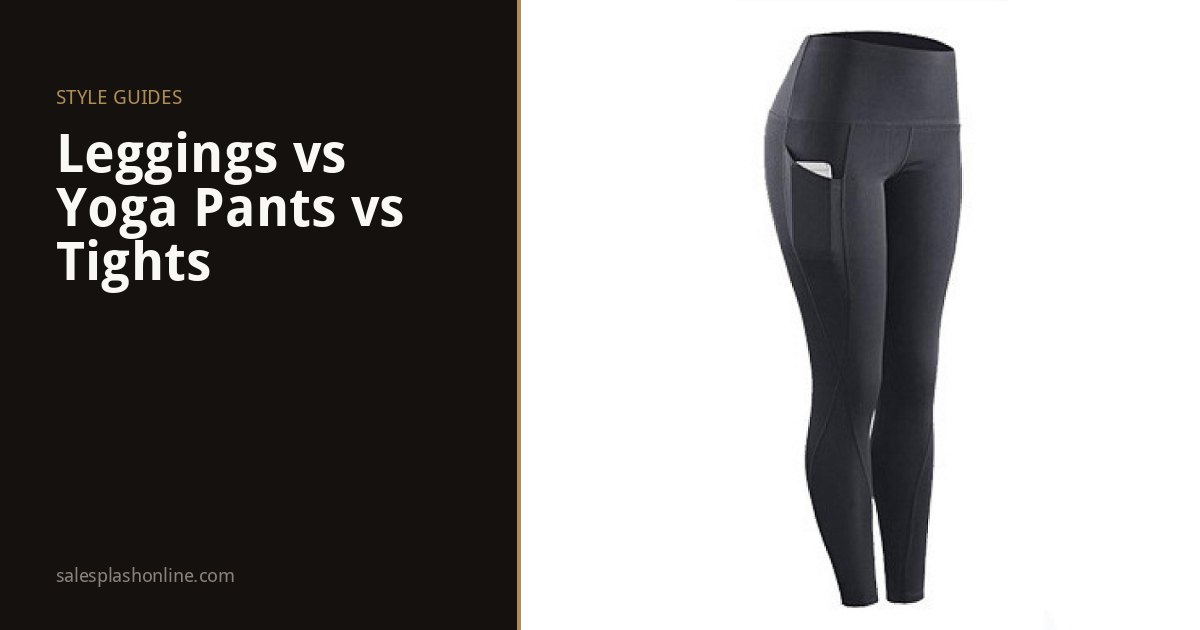
Leggings are footless, opaque stretch trousers made to be worn on their own. Yoga pants are leggings (or flares) built for mat work, with a high waist and a dense knit that stays opaque in deep stretches. Tights are hosiery: usually footed, graded by denier from sheer to opaque, and worn under clothes rather than alone.
Key takeaways
- Worn alone? Leggings and yoga pants, yes. Tights, generally no.
- Feet: tights are usually footed; leggings and yoga pants are footless.
- Weight: tights are graded in denier (grams per 9,000 m of yarn); roughly 20 denier is sheer and 30 is semi-opaque.
- Yoga pants as a skin-tight nylon-and-Lycra garment date from 1998, when Lululemon started selling them in Vancouver.
- For training, choose a nylon or polyester blend with elastane over cotton. Cotton absorbs roughly 10 times more moisture than polyester.
The three terms get used interchangeably, but knowing which one you actually want saves a mis-buy. Below: what each garment is, how they compare side by side, and which to reach for.
Leggings
Footless, opaque, stretch-knit trousers worn as outerwear. Thickness varies from lightweight summer knits to fleece-lined winter pairs. The defining trait: opaque enough to wear alone. Wikipedia’s hosiery entry draws the same line, describing leggings as differing from tights chiefly in that they can be worn as outerwear (Wikipedia, “Pantyhose”).
Leggings cover the widest range of any of the three. The same word describes a thin everyday cotton blend, a sculpting high-waist gym pair, a faux leather evening legging and a thermal winter pair. What they share is a close fit through the whole leg, no fastenings and enough fabric density to be worn without anything over them. That stretch comes from spandex, the fibre DuPont chemist Joseph Shivers invented in 1958 and sold as Lycra (Textile World, 2018). Spandex can stretch to about five times its length (Wikipedia, “Spandex”).
Yoga pants
Technically a broader family that includes flare and bootcut cuts as well as tight ones. Yoga pants in nylon and Lycra came onto the market in 1998, sold by Lululemon in Vancouver (Wikipedia, “Yoga pants”; “Lululemon”). In practice, “yoga pants” today usually means a performance legging with a high waist and construction details for mat work. Those details are smooth front seams that do not press in during a forward fold, and dense knits that stay opaque in deep stretches. Browse our yoga range to see the difference in construction.
The original yoga pant was looser, often flared from the knee, in a soft cotton-stretch jersey. That style is back in fashion as the flare legging, but most people searching for yoga pants now mean something skin-tight.
The category is large. In the year to June 2014, NPD Group data showed US sales of yoga pants and other activewear up 7% to $33.6 billion, while jeans fell 6% to $16 billion (Associated Press via WTOP, 2014). Amanda Hallay, a fashion merchandising professor at LIM College, told the AP: “Everyone wants to look like they’re running to the gym, even if they’re not.”
Tights
The sheerer, footed (or stirrup) garment worn under things rather than as trousers. Tights are graded by denier, the mass in grams of 9,000 metres of yarn (Wikipedia, “Units of textile measurement”). Roughly, 20 denier is standard sheer and 30 is semi-opaque, with heavier counts running up to fully opaque (Wikipedia, “Pantyhose”). Our thermal tights sit in between: tight-weight construction with legging-level warmth.
Running “tights” muddy this further. In sportswear the word often means a close-fitting performance legging, usually footless, sometimes with reflective details and a zip pocket. If a product is sold as a running tight and has no foot, treat it as a legging.
Leggings vs yoga pants vs tights at a glance
| Leggings | Yoga pants | Tights | |
|---|---|---|---|
| Worn alone | Yes | Yes | Generally no (under skirts, dresses, shorts) |
| Feet | Footless | Footless | Usually footed or stirrup |
| Fit | Skin-tight | Skin-tight or flared | Skin-tight |
| Opacity | Opaque | Opaque, built to stay so in deep stretches | Sheer to opaque, by denier |
| Fabric weight | Wide range, light to fleece-lined | Dense, mid to heavy | Lightest; measured in denier |
| Waistband | Varies | Wide and high | Narrow elastic band |
| Best for | Training, errands, everyday wear | Yoga, pilates, floor work | Warmth and coverage under other clothes |
Fabric: what separates a good pair
For anything you will move in, look for a nylon or polyester blend with a decent share of elastane. Nylon feels softer and has a slight sheen. Polyester holds prints well and absorbs very little water. Standard moisture regain is 0.4–0.8% for polyester, 4.0–4.5% for nylon 6,6 and 7–11% for cotton (Wikipedia, “Yarn conditioning”, citing Kadolph, Textiles). That is why cotton blends are comfortable for lounging but hold sweat and lose shape over a long session. Our fabric guide goes through each blend in detail.
| Fibre | Moisture regain | What it means in a legging |
|---|---|---|
| Polyester | 0.4–0.8% | Barely absorbs sweat; strong prints |
| Nylon 6,6 | 4.0–4.5% | Soft hand, slight sheen, very durable |
| Cotton | 7–11% | Comfortable at rest; holds sweat in a workout |
Opacity is where cheap pairs fail. A legging can look solid on the hanger and go sheer in a squat. That matters most for yoga, where deep stretches put the most strain on the fabric. Our squat-proof test shows how to check a pair before you wear it out.
Which to buy
- Wearing them alone to train or run errands → leggings
- Yoga, pilates, deep stretching → yoga pants with a smooth front seam
- Under dresses and trousers for warmth → tights
- Cold-weather walks and commutes → fleece-lined leggings
- Evenings out → faux leather or ponte leggings, which read as trousers
Whichever you choose, the sizing rule is the same: international sizing runs about one size smaller than US. Our size guide covers how to measure.
Frequently asked questions
What is the difference between leggings and yoga pants?
Yoga pants are a kind of legging designed for mat work. They have a wide, high waist, a smooth or seam-free front and a denser knit that stays opaque in deep stretches. Plain leggings vary more in weight and waistband. Yoga pants can also be flared, which leggings never are.
Can you wear tights as leggings?
Only the thickest opaque styles, and even then they tend to go sheer at the seat when you bend. Tights are made to be worn under other clothes, so for wearing on their own, choose leggings.
Are yoga pants just expensive leggings?
Not quite. A good yoga pant has construction choices a basic legging skips: a smooth or no-front seam, a high supportive waist and a denser knit. Whether that is worth it depends on how much floor work you do.
What does denier mean on tights?
Denier is the weight in grams of 9,000 metres of the yarn. The higher the number, the thicker and more opaque the tights. Around 20 denier is standard sheer, around 30 is semi-opaque, and heavier counts are opaque.
Do leggings count as trousers?
In most casual settings, yes. For more formal occasions, see our guide to wearing leggings to dressier events.
Are running tights the same as leggings?
Usually, yes. In sportswear, “running tights” normally means a footless performance legging, often with reflective details or a zip pocket. If it has no foot, treat it as a legging.
Sources
- Wikipedia, “Pantyhose” (tights vs leggings; denier ranges): https://en.wikipedia.org/wiki/Pantyhose
- Wikipedia, “Units of textile measurement” (denier definition): https://en.wikipedia.org/wiki/Units_of_textile_measurement
- Jim Borneman, “Lycra Brand Celebrates 60 Years Of Groundbreaking Innovations”, Textile World, May 2018: textileworld.com
- Wikipedia, “Spandex”: https://en.wikipedia.org/wiki/Spandex
- Wikipedia, “Yoga pants”: https://en.wikipedia.org/wiki/Yoga_pants and “Lululemon”: https://en.wikipedia.org/wiki/Lululemon
- Anne D’Innocenzio, “Jeans face an uncertain future amid yoga wear rage”, Associated Press via WTOP, September 2014: wtop.com
- Wikipedia, “Yarn conditioning” (moisture regain table, citing Sara J. Kadolph, Textiles): https://en.wikipedia.org/wiki/Yarn_conditioning