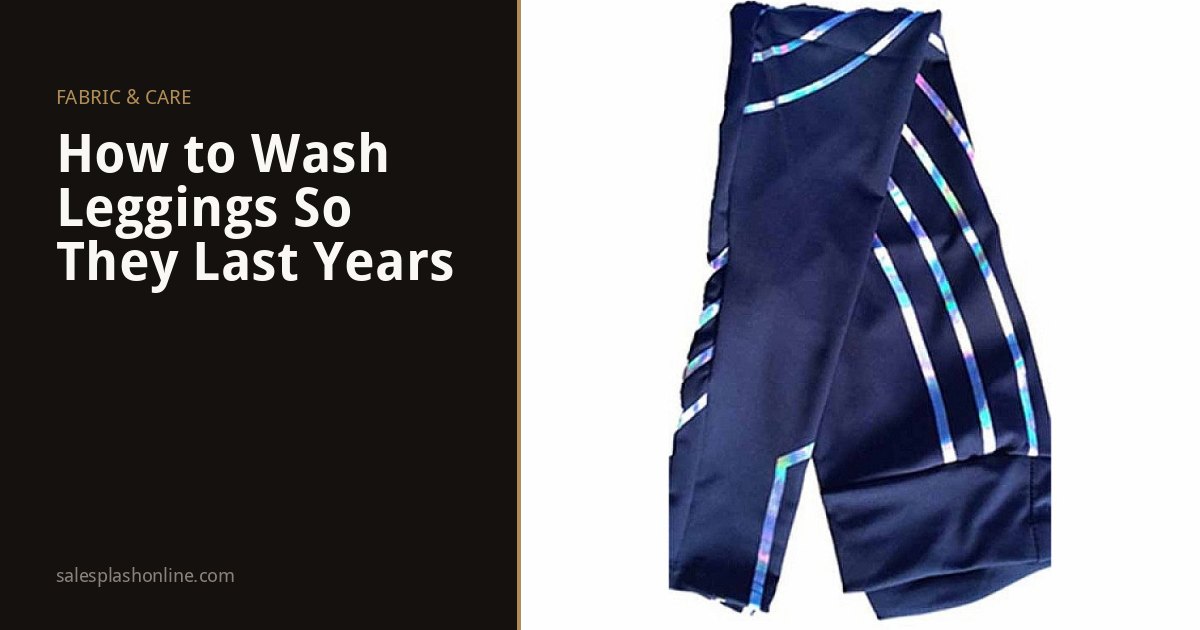
To wash leggings so they last, turn them inside-out and machine wash them cold (86°F / 30°C or below) with a small dose of liquid detergent and no fabric softener. Hang or lay them flat to dry, out of direct sun, and never tumble dry them. Heat is what destroys the elastane that gives leggings their stretch.
Key takeaways
- Cold water is enough. ENERGY STAR says cold water “will generally do a good job of cleaning” unless there are oily stains, and heating water uses about 90% of a washer’s energy.
- “Cold” on a US care label means water up to 86°F (30°C), under the FTC Care Labeling Rule.
- No tumble dryer. The LYCRA Company’s own care advice: “heat and spandex don’t mix.”
- Wash after every sweaty session. In a 26-person study, polyester workout shirts smelled worse than cotton ones because odour bacteria favoured the synthetic fabric.
- Use a mesh wash bag and a full load, not the delicate cycle. Delicate cycles released about 800,000 more microfibres per wash in Newcastle University tests.
Most leggings do not wear out; they get washed out. The elastane is damaged by heat and coated by softener, and both failures are avoidable. Here is the routine that keeps a good pair good, plus what to do when something has already gone wrong.
Why leggings fail in the wash
A legging is usually a blend. A base fibre such as nylon or polyester provides strength, and it is knitted together with elastane (also sold as spandex or Lycra) for stretch. The base fibre is tough. The elastane is not. It is a rubber-like polymer, and three things break it down: heat, chemicals that coat or strip it, and friction. The LYCRA Company puts it bluntly: “Heat is an enemy of spandex, so cool water is important” (The LYCRA Company, 2026). When the elastane goes, the legging goes with it. The knees bag, the waistband stops gripping, and the fabric turns thin and shiny at the seat.
That is also why an old pair can go see-through even when it looks fine on the hanger. Stretch recovery has gone, so the knit opens up further every time you bend. Our squat-proof test shows how to check a pair before it lets you down.
The five rules
- Cold water, always. Warm washes slowly cook the elastane. Cold cleans activewear well, because sweat is water-soluble. On a US care label, “cold” means an initial water temperature up to 86°F (30°C) (FTC Care Labeling Rule, 16 CFR 423).
- Never tumble dry. This is the single biggest killer. Hang them and they are dry in hours.
- Skip fabric softener. It leaves a coating on the fibres. In a University of Tennessee study, fabrics laundered with dryer-cycle softener showed lower wicking heights, the study’s measure of how well a fabric moves moisture (Andrews, University of Tennessee, 1978). That study tested shirting fabric rather than activewear, but sports fabrics should never feel “softened” anyway.
- Wash inside-out. This protects prints and tie-dye, and puts the sweat-facing side against the detergent.
- Close zips and wash with soft things. Velcro and zips in the same drum are what cause pilling and pulls.
Wash settings at a glance
| Setting | Do | Avoid | Why |
|---|---|---|---|
| Water temperature | Cold, up to 86°F / 30°C | Warm (87–111°F) or hot (112–145°F) | Heat degrades elastane; heating water is ~90% of washer energy |
| Cycle | Normal or synthetics, full load, gentle spin | Delicate cycle | Delicate cycles use more water and released ~800,000 more microfibres |
| Detergent | Small dose of liquid | Excess detergent, powder in cold water | Residue traps odour; liquid dissolves better cold |
| Softener | None | Fabric softener, dryer sheets | Coats fibres and reduces wicking |
| Drying | Hang or lay flat, out of direct sun | Tumble dryer, radiator, wringing | “Heat and spandex don’t mix” |
| Extras | Mesh wash bag | Washing with zips, hooks, Velcro | A wash bag cut microfibre release by about 54% in tests |
Machine or hand wash?
A machine is fine for almost every pair, as long as you use a cold wash with a gentle spin. A mesh laundry bag is worth the small cost. It stops leggings wrapping around heavier items and cuts the friction that causes pilling. In University of Plymouth tests, the Guppyfriend wash bag also reduced microfibre release to wastewater by around 54% (Napper, Barrett & Thompson, Science of the Total Environment, 2020). Hand washing is only really worth the effort for pairs with delicate mesh panels, faux leather or heavy embellishment.
Do not assume the “delicate” cycle is kinder, though. Newcastle University researchers found that 800,000 more fibres were released in a delicate wash than a standard cycle, because of the higher volume of water (Newcastle University, 2019). Lead author Max Kelly recommended avoiding high water-to-fabric washes such as delicate cycles and running full loads. A single 6 kg load of synthetic acrylic can shed over 700,000 fibres (Napper & Thompson, Marine Pollution Bulletin, 2016), and every fibre lost is fabric your leggings no longer have.
Use less detergent than you think. Activewear holds on to excess detergent, and the build-up traps odour, which is the opposite of what you want. A liquid detergent dissolves more reliably in cold water than powder.
How often?
Wash after every sweaty session. Synthetic fabrics hold on to odour. In a Ghent University study, shirts were collected from 26 people after a fitness class. The polyester shirts “smelled significantly less pleasant and more intense” than the cotton ones, and odour-linked micrococci were found almost only on the synthetics (Callewaert et al., Applied and Environmental Microbiology, 2014). For light wear, every two to three outings is fine. Never leave a sweaty pair balled up in a gym bag overnight; if you cannot wash it straight away, hang it to air out.
When the smell will not shift
Soak in one part white vinegar to four parts cold water for thirty minutes before washing. The vinegar smell rinses out completely. If odour keeps coming back, you are probably using too much detergent or softener. Cut both back and it usually clears within a few washes.
Drying without damage
Lay flat or hang over a rail, out of direct sun. Strong sunlight fades dark colours and weakens elastane over time, in the same way it perishes a rubber band. Do not wring leggings out. Roll them in a towel and press to remove the worst of the water. Most performance knits are dry in two to four hours at room temperature; quick-dry fabrics are faster still.
If a garment label says only “tumble dry” with no temperature, the FTC rule treats that as permission for a hot setting (16 CFR 423). So the absence of a warning is not a reason to use the dryer.
Special fabrics
- Fleece-lined: wash inside-out so the brushed pile is protected, and let them dry fully before storing. Our fleece-lined guide covers how the lining works.
- Faux leather: hand wash or wipe clean where possible, never iron, and dry flat. Heat cracks the coating.
- Compression: cold wash and air dry without exception. The support comes entirely from the elastane, so heat damage shows up here first.
- Seamless: the knit is continuous, so snags spread. Keep them away from hooks, zips and Velcro.
Storage
Fold rather than hang, because hanging stretches the waistband over time. And never store fleece-lined pairs compressed while damp; the pile flattens permanently.
Signs it is time to replace a pair
- The fabric goes sheer when you bend, even though it used to be opaque
- The waistband rolls down or no longer grips
- Bagging at the knees that does not recover after washing
- Pilling across the inner thighs that has turned rough
Follow all of this and a quality pair, like our nylon knits, will genuinely last years.
Frequently asked questions
What temperature should I wash leggings at?
Cold: an initial water temperature up to 86°F (30°C), which is what “cold” means on a US care label. Heat damages the elastane that gives leggings their stretch, and cold water cleans sweat out well.
Can you put leggings in the dryer?
No. Tumble drying is the fastest way to ruin leggings, because heat breaks down spandex. Hang them or lay them flat out of direct sun; most performance knits dry in two to four hours.
Should I use fabric softener on leggings?
No. Softener leaves a coating on the fibres that can reduce stretch recovery and wicking, and the build-up can trap odour. Use a small dose of liquid detergent and nothing else.
How often should you wash leggings?
After every sweaty workout, because sweat left in a synthetic knit feeds odour-causing bacteria. Pairs worn lightly for errands or lounging can go two to three wears between washes.
How do I get the smell out of gym leggings?
Soak them for 30 minutes in one part white vinegar to four parts cold water, then wash cold. If the smell keeps returning, cut back on detergent and stop using softener; residue build-up is the usual cause.
Is the delicate cycle better for leggings?
Not necessarily. Delicate cycles use more water, and in Newcastle University tests they released about 800,000 more microfibres than a standard cycle. A cold normal or synthetics cycle with a gentle spin, a full load and a mesh wash bag is the better choice.
Sources
- ENERGY STAR, “Clothes Washers” (water heating share; cold-water cleaning): https://www.energystar.gov/products/clothes_washers
- US Federal Trade Commission, Care Labeling Rule, 16 CFR Part 423, Appendix A (cold/warm/hot definitions; tumble-dry wording): https://www.ecfr.gov/current/title-16/chapter-I/subchapter-B/part-423
- The LYCRA Company, “Discover the Secret to Durable Swimwear”, 2026: https://www.lycra.com/en/business/news/discover-secret-durable-swimwear
- Kathryn V. Andrews, “Effects of commercial dryer cycle fabric softeners on selected parameters of shirting weight fabrics”, University of Tennessee, 1978: trace.tennessee.edu
- Callewaert C. et al. (Ghent University), “Microbial Odor Profile of Polyester and Cotton Clothes after a Fitness Session”, Applied and Environmental Microbiology 80(21), 2014: https://pmc.ncbi.nlm.nih.gov/articles/PMC4249026/
- Newcastle University press release on delicate-cycle microfibre release, September 2019 (Kelly et al., Environmental Science & Technology): https://www.ncl.ac.uk/press/articles/archive/2019/09/microfibres/
- Napper I.E. & Thompson R.C. (University of Plymouth), study of microfibre release from domestic washing, Marine Pollution Bulletin 112(1–2):39–45, 2016: doi:10.1016/j.marpolbul.2016.09.025
- Napper I.E., Barrett A.C. & Thompson R.C., “The efficiency of devices intended to reduce microfibre release during clothes washing”, Science of the Total Environment 738, 2020: doi:10.1016/j.scitotenv.2020.140412
Shop this guide: quick-dry leggings · compression leggings