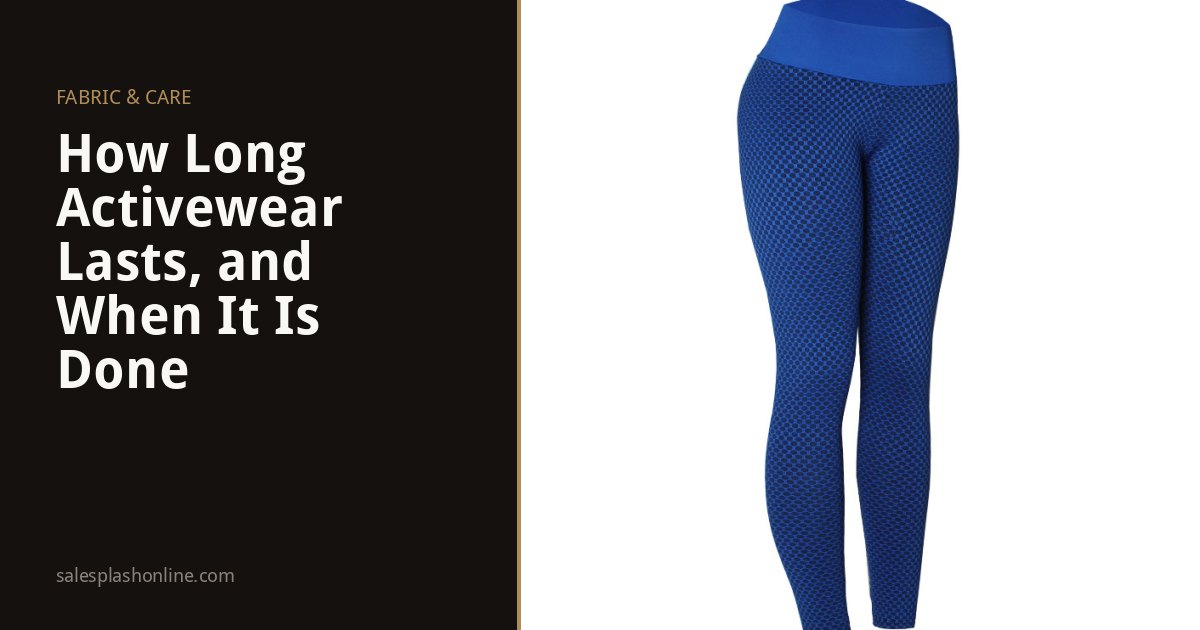
Activewear does not fail suddenly. It degrades slowly enough that you adjust to it without noticing, which is why most people keep wearing leggings well past the point where they have stopped doing their job. Here is roughly how long the components actually last, what kills them, and the specific signs that a pair is finished.
What is actually wearing out
A performance legging is a blend, typically a nylon or polyester base with somewhere between 8 and 25 per cent elastane. Those two components fail on completely different timescales.
The nylon or polyester is durable. Barring abrasion or a snag, the base fibre will outlast your interest in the garment. It is the elastane that dies, and everything you notice as a legging “going” is elastane losing its ability to return to its original length. When people say a fabric has “gone baggy”, what has actually happened is that the elastic component has lost recovery while the base fibre stayed exactly the same length.
This is why the failure is gradual and why it is irreversible. There is no wash, treatment or drying method that restores elastane.
Realistic lifespans
Assuming reasonable care, roughly:
- Leggings worn for training two or three times a week — around one to two years before recovery is noticeably gone.
- Leggings worn casually once or twice a week — three years or more, because the fabric spends less time at high stretch.
- Heavy compression pieces — often shorter, one year or less with regular use, because they operate nearer the fabric’s limit every session.
- Fleece-lined winter styles — the lining mats before the elastane fails. Two to three seasons, and the failure is comfort rather than fit.
- Sports bras — the shortest-lived item in the drawer, six to twelve months of regular use, for the same elastane reason under constant tension.
Those are ranges, not promises. What moves a garment toward the short end is almost always laundry rather than wear.
The things that actually kill it
- Heat. The single largest factor. Hot washes and tumble dryers both relax and permanently damage elastane. A tumble dryer will take years off a legging faster than anything you do while wearing it.
- Fabric softener. It coats fibres, which destroys wicking and leaves a residue that traps odour. Never use it on performance fabric.
- Sweat left to sit. Sweat is mildly acidic and salty, and both degrade elastane. Kit left damp in a bag overnight is being chemically attacked the whole time.
- UV. Direct sunlight degrades elastane. Drying on a sunny windowsill or a washing line in strong sun is quietly damaging.
- Chlorine. Extremely destructive if you swim in them.
- Abrasion. Gym benches, rowing seats and rough seating wear the seat and the outer thigh. This is the one failure that is genuinely about use rather than care.
How to tell a pair is finished
Six honest signs. Two or more together and the pair is done.
- They no longer return to shape. Take them off and look at the knees. If there are permanent bags that do not relax after a rest and a wash, the elastane is gone.
- You are pulling them up during a session. If a pair that used to stay put now needs adjusting, it has lost recovery at the waist.
- They have become sheer. Fabric that has been stretched repeatedly thins permanently. If a pair passes the squat test when new and fails it a year later, that is degradation rather than a design fault.
- Odour survives washing. Once bacteria are established in the fibre structure, it is effectively permanent. This is the most common reason to retire otherwise sound kit.
- Pilling in the friction zones. Inner thigh and seat. Cosmetic at first, but it indicates the surface is breaking down.
- The waistband has lost its snap. Stretch it and let go. If it returns slowly or not fully, the band is finished even if the legs look fine.
Doubling the life, in practice
- Wash cold, always. 30°C or below. This is the highest-impact change available.
- Turn inside out. Protects the face fabric from abrasion and gets the sweat side properly clean.
- Never tumble dry. Air dry, out of direct sun, on a rack rather than over a radiator.
- Skip the softener and use a modest amount of ordinary detergent. More detergent is not better and residue holds odour.
- Wash separately from zips, hooks and velcro, which cause the snags that finish textured knits.
- Rotate. Elastane recovers with rest. Three pairs in rotation will each last more than three times as long as one pair worn constantly — this is the least obvious and most effective habit on the list.
- Do not iron, ever.
The washing guide goes into more detail, and the piece on textured knits covers the extra care those need.
Buying with lifespan in mind
Two things predict longevity better than price. Fabric weight — heavier knits have more material to lose before they become sheer, so they age more gracefully. And construction — a seamless garment has no seams to fail, while flatlock seams outlast standard overlocked ones.
Beyond that, buying fewer pairs of heavier fabric and rotating them will comfortably outlast buying more pairs of lightweight fabric, both in months of use and in what it costs you over time.
When they are done
Retired leggings are still useful. They make perfectly good layers under winter clothing, gardening or decorating kit, or a base layer for cold walks where sheerness and shape do not matter. Synthetic fabric is not readily recyclable through household collection, but many larger clothing retailers operate textile take-back schemes that accept worn synthetics, which is a better destination than landfill.
If you are replacing a pair, the fabric guide covers what to look for, and the leggings range has the current selection.