“Breathable” is the most overworked word in activewear. It gets printed on garments that trap heat and on garments that shed it, and it describes at least two entirely different properties that behave differently in the heat. If you are buying for summer, it helps to know which one you actually need.
Two different things, both called breathable
The first is air permeability: whether air can physically pass through the fabric. This is a matter of construction — how open the knit is, whether there are mesh zones, how densely it is stitched. It is what cools you when there is a breeze or when you are moving fast enough to create one.
The second is moisture management: what the fabric does with sweat. This is a matter of fibre chemistry rather than construction. It determines whether you end up damp and clinging or dry and comfortable, and it matters more than airflow on a still, humid day.
A fabric can be good at one and poor at the other. Cotton is reasonably air-permeable and terrible at moisture management. A dense technical knit can be the reverse. Knowing which problem you are solving tells you what to buy.
Mesh panels: functional or decorative
Mesh is the most visible summer feature and the most inconsistently applied. Its job is to create openings where your body vents heat, so placement is everything.
Functional placement puts mesh where heat actually accumulates and where the garment does not need to hold you: behind the knee, along the outer calf, up the back of the thigh, or in a band at the waistband’s lower edge. These are low-stress areas, so an open knit there does not compromise the fit.
Decorative placement puts mesh in narrow strips at the ankle, in small side cut-outs, or in symmetrical panels chosen because they look like sportswear. These vent almost nothing. They are a styling choice, which is fine as long as you are not paying for cooling you will not get.
A quick test before buying: look at where the mesh sits relative to the back of the knee. If nothing is happening there, the mesh is mostly aesthetic.
Quick-dry, and why cotton is the wrong summer fabric
Quick-dry is not a coating. It is a consequence of fibre chemistry. Polyester and nylon are hydrophobic — the fibres themselves absorb very little water. Sweat therefore sits on the surface and in the spaces between fibres, where capillary action can pull it outward and air can evaporate it. The fabric is not absorbing the moisture so much as transporting it.
Cotton does the opposite. Cotton fibres are hydrophilic and can hold a substantial fraction of their own weight in water. It feels lovely and cool for the first twenty minutes, then becomes saturated, heavy, and cold against the skin as it slowly evaporates. In a summer legging or short this is genuinely uncomfortable, and it is also what causes most chafing. Cotton blends have their place in a low-intensity context; for heat and movement, synthetics win clearly.
The fabric guide goes into how nylon and polyester differ from each other, which matters less in summer than the fact that both beat cotton.
Seamless knitting and ventilation zones
Seamless garments are knitted as a tube on a circular machine rather than cut from flat fabric and sewn. That has two summer-relevant consequences.
First, there are no side seams, which removes the ridge that most commonly causes rubbing on a hot day when skin is damp. Second, because the machine can vary stitch density as it knits, a single garment can carry dense supportive zones and open breathable zones without a single join. This is the most elegant version of ventilation — the mesh is not a panel sewn in, it is the same fabric knitted more openly.
It is also the reason seamless styles tend to cope best with being between sizes, which is worth knowing if you are ordering without having measured.
Shorts or leggings in the heat
The instinctive answer is shorts, and it is not always right.
Bare skin cools efficiently, but bare thighs also rub. For anyone whose thighs touch when they walk — which is most people — a short that ends mid-thigh in humid weather is a reliable route to chafing within a few miles. A longer close-fitting short, or a light legging in a hydrophobic knit, can genuinely be more comfortable in the heat than a loose short, because the fabric moves against itself rather than skin against skin.
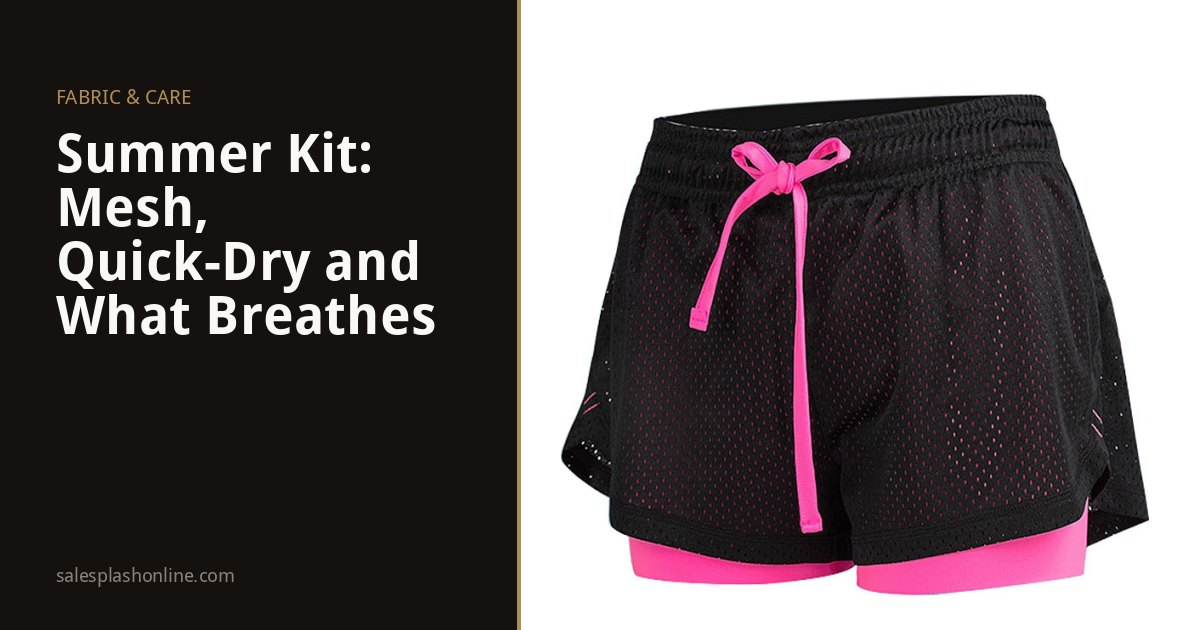
This is what 2-in-1 shorts exist to solve: a loose outer shell for airflow and appearance, with a fitted inner liner that handles the rubbing. If you have found summer running uncomfortable and blamed the weather, this construction is usually the fix.
Colour, and a small honest caveat
Dark fabrics absorb more radiant heat in direct sun, so a black legging genuinely does get hotter than a pale one standing still in strong sunlight. The effect is real but modest, and it is easily outweighed by fabric choice and fit. Do not buy the wrong fabric in a lighter colour and expect to be cooler.
Pale colours have their own summer problem: they are more prone to going sheer under stretch, because there is less pigment in the yarn to block light. If you are buying pale summer leggings, the squat test is worth doing before you commit.
Summer care matters more than winter care
Sweat is mildly acidic and contains salts, and both degrade elastane faster than plain water does. In summer this is the main thing shortening the life of your kit.
- Do not leave damp kit in a bag. A few hours is enough to set odour into synthetic fibres permanently.
- Rinse if you cannot wash promptly. Cold water removes most of the salt.
- Cold wash, no softener. Softener coats hydrophobic fibres and destroys exactly the wicking behaviour you paid for.
- Air dry out of direct sun. UV degrades elastane, so a sunny windowsill is not a good drying rack.
The washing guide covers the rest.
What we stock for warm weather
The summer-relevant part of the range, grouped by what it actually does:
- Mesh-Panel Seamless Gym Leggings — knitted ventilation zones rather than sewn-in panels.
- Mesh-Panel Yoga Leggings with Pockets and Seamless Mesh-Panel Yoga Leggings — ventilation with somewhere to put a phone.
- Mesh Panel Running Shorts — seven colourways, S to XXL, cut for summer running.
- 2-in-1 Marathon Running Shorts and Double-Layer Running Shorts with Pocket — loose shell over a fitted liner, the anti-chafe construction.
- Breathable Compression Gym Shorts — close-fitting, short on the leg, for training rather than distance.
- Quick-Dry Running Shorts and Quick-Dry Textured Gym Leggings — hydrophobic knits for humid days.
- Two-Tone Seamless Running Tights — fast-drying, no side seams.
Browse the full shorts range or the leggings range.
Shop this guide: mesh leggings · quick-dry leggings · running shorts · seamless shorts