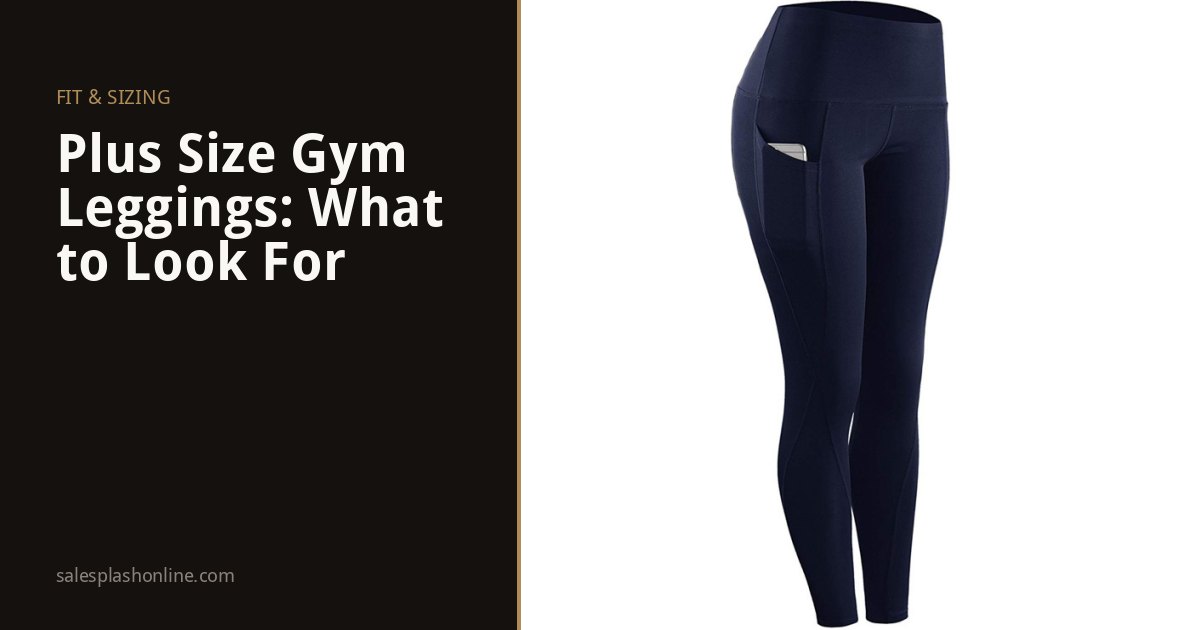
The best plus size gym leggings pass four checks: a dense seamless or textured knit that stays opaque in a deep squat, a high, wide waistband that does not fold when you hinge, no inner-thigh seam to chafe, and a size run that genuinely reaches your hip measurement. Check those before the price or the print.
Key takeaways
- Plus size is mainstream sizing. Research using CDC body data puts the average American woman at a size 16–18, and the CDC’s latest average waist for US women is 38.5 inches.
- Opacity first: a knit at the top of its stretch range lets more light through, so choose dense seamless or textured fabric and run a squat test.
- Waistband roll comes from rise and width, not size: a wide band at or above the natural waist stays put.
- Chafing: the American Academy of Dermatology advises moisture-wicking clothing and avoiding cotton. Seamless leggings remove the inner-thigh seam entirely.
- Compression is optional. A 23-study meta-analysis found only a small recovery benefit, and a systematic review found no significant effect on running performance.
Buying leggings for training is a different problem from buying them to wear around, and it gets harder further up a size run. The failure modes are specific: fabric that turns sheer under a squat, waistbands that roll during movement rather than while standing still, and inner-thigh seams in the one place friction will find them. Here is what actually matters, and an honest account of how much of it we can supply.
Why this matters: plus size is the average
Washington State University researchers Christel and Dunn used CDC body-measurement data to estimate US women’s clothing sizes. They concluded that the average American woman wears between a 16 and an 18 (Christel & Dunn, International Journal of Fashion Design, Technology and Education, 2016; reported by TODAY). The CDC’s most recent survey data, from August 2021 to August 2023, gives an average waist circumference of 38.5 inches for women aged 20 and over (CDC/NCHS FastStats).
Yet activewear has lagged. A 2016 WSU study found plus-size women often wear men’s clothing to exercise. It cited one major athletic brand offering 8 plus-size women’s items against more than 2,000 in smaller sizes (WSU News, 2016). That matters for more than shopping. In a 2024 survey of 130 women who wear US size 14 or above and exercise at least twice a week, dissatisfaction with plus-size exercise clothing was a strong predictor of wanting to avoid exercise (Greenleaf & Hauff, Sex Roles, 2024, via PsyPost). Kit that works keeps people training.
Opacity is the first requirement, not a nice-to-have
In a gym you bend, kneel and squat under bright, often overhead lighting, with people behind you. That is the worst possible combination for a knit at the top of its stretch range, and it is why opacity should be the first thing you check rather than an afterthought.
The mechanism is straightforward: the same yarn covering a larger area lets more light through. We have written about why it becomes more pronounced at larger sizes. For training specifically, prioritise a dense seamless knit or a textured one, in a dark colour, and run the squat test in daylight before the tags come off.
The waistband is the second, and it is about movement
Most waistband advice is written for standing still. Training is repeated flexion, and a waistband that is perfectly stable while you stand can fold over within two sets of anything involving a hip hinge.
Three things determine whether it stays put:
- Height. A genuinely high rise sitting at or above the natural waist has more surface holding it in place and less tendency to fold. A mid rise sitting on the widest part of the hip is being pushed down every time you bend.
- Width. A wide band distributes tension over more area. A narrow elasticated band concentrates it into a line, which is what creates the fold.
- Construction. A band knitted continuously with the body has nothing to roll along. A separate band sewn on has a seam, and the seam is the hinge.
If waistband roll has been your experience, it is usually rise and width rather than size. This piece covers the mechanics.
Seams and chafing
The inner thigh is where training kit fails most often, and it fails faster when skin is damp. The American Academy of Dermatology defines chafing as irritation that occurs “when body parts rub together or rub against clothing”. It suggests petroleum jelly on problem areas such as the thighs (AAD). For exercise, the AAD advises moisture-wicking clothes and avoiding cotton, “as cotton soaks up sweat and moisture, which can lead to friction and chafing” (AAD).
Any seam running along the inner leg is a friction point. A flat-locked seam is better than a standard one, but it is still there. Seamless construction removes the question. Because the garment is knitted as a tube rather than cut and sewn, there is no inner-leg seam to rub at all. For anyone whose thighs touch when they walk, which is most people and more so at larger sizes, this is the single most valuable feature available. It matters well ahead of any styling consideration. Our explainer on seamless knitting covers how it is made.
Compression versus comfort, and being honest about it
Compression garments apply graduated pressure. Some people find that supportive during training; others find it restrictive over a full session. The evidence for performance gains is modest. A 2017 meta-analysis of 23 studies found compression gave “small, very likely benefits” for recovery (effect size 0.38). The largest effect was on strength recovery, especially after resistance exercise (Brown et al., Sports Medicine, 2017). A systematic review of runners found compression clothing had no statistically significant mean effect on running performance (Engel, Holmberg & Sperlich, Sports Medicine, 2016). So choose compression for how it feels, not because it will make you faster.
The relevant point for larger sizes is that compression comes from fabric tension. A compression legging at the top of its size range is therefore working nearer its limit than the same style in a mid size, which brings us back to opacity and to recovery. If you want the supportive feel without that, a firm high-waisted seamless knit gives most of the sensation with more margin in the fabric.
Length, and why full-length is often the right call
The instinct in a hot gym is to go shorter. For training at larger sizes, full-length or a long short is often more comfortable, because it puts fabric between skin surfaces that would otherwise rub. A mid-thigh short is the worst of both: short enough to expose the contact point, long enough to ride up into it.
If you want shorts, look for a genuinely long cut or a double-layer construction with a fitted inner liner. If you want to stay cool rather than wear something short, a lightweight full-length legging in a quick-drying knit will usually beat a short on comfort over an hour.
What to check before buying
| Check | Good sign | Warning sign |
|---|---|---|
| Opacity | Dense seamless or textured knit, dark colour | Thin, smooth, pale fabric; no squat test possible |
| Waistband | High rise at or above the natural waist; wide, knitted-in band | Mid rise on the hip; narrow sewn-on elastic |
| Inner thigh | Seamless, no inner-leg seam | Standard overlocked inner-leg seam |
| Fabric | Moisture-wicking nylon or polyester with elastane | Cotton-heavy blend (holds sweat) |
| Size run | Chart in centimetres that reaches your hip | “Plus size” label with a chart that stops short |
| Length | Full length or a long short with liner | Mid-thigh short that rides up |
- Measure, then read the chart in centimetres. Our sizing is international and runs about one size smaller than US sizing. Our XXL is roughly a US XL (16–18), and XXXL roughly a US XXL (20–22). The size guide has the full chart.
- Go by the hip where waist and hip fall in different rows. The leg does the work; the waistband has stretch to spare.
- Check the size run actually extends rather than the listing merely carrying a plus-size label.
- Prefer seamless or textured knits for opacity and friction.
- Check the rise height against where your natural waist actually is, not against the photograph.
What we can actually supply, honestly
This is the part worth being straight about. Across our whole catalogue, 19 products go to XXL or larger and only 9 go beyond that. When you narrow to training styles specifically, the list is short:
| Style | Size range | Construction | Best for |
|---|---|---|---|
| Seamless High-Waist Gym Leggings | S to 3XL | Seamless compression, tummy-control high waist | The best single answer here |
| Seamless High-Waist Leggings | S to 3XL | Dense seamless knit | The lowest-priced of the four |
| High-Waist Cycling Leggings | S to 3XL | Firm high waist, cut as outerwear | Cycling and general training |
| Quick-Dry Compression Leggings | To 2XL | Compression; sold as separates with a matching bra | Hot sessions, if 2XL fits you |
Four styles is not a wide choice and we would rather say so than pad the list. If none of those work for you, the honest recommendation is to buy elsewhere rather than buy the wrong thing here. Our plus size page lists every style where the larger sizes genuinely exist, training or otherwise, and this piece explains how the sizing converts.
If you are unsure between two sizes
Send your waist and hip measurements to contact@salesplashonline.com and we will tell you which row of the chart a specific style puts you in. For training kit particularly, that is worth doing before ordering. A legging that is marginal on opacity or slightly too small at the hip will not become comfortable with wear.
Frequently asked questions
What should I look for in plus size gym leggings?
Four things: a dense, opaque knit that passes a squat test; a high, wide waistband that does not fold when you bend; seamless construction with no inner-thigh seam; and a size chart that genuinely reaches your hip measurement.
How do I stop plus size leggings rolling down at the gym?
Choose a high rise that sits at or above your natural waist, with a wide band knitted into the body rather than a narrow sewn-on elastic. Roll is usually caused by rise and width, not by the size being wrong.
How do I stop thigh chafing in leggings?
Pick seamless leggings with no inner-leg seam, in a moisture-wicking nylon or polyester rather than cotton. The American Academy of Dermatology also suggests petroleum jelly on problem areas such as the thighs.
Are compression leggings worth it for plus size workouts?
Only if you like the feel. Research shows a small benefit for recovery and no significant effect on running performance. At the top of a size range, compression fabric is also working near its limit, so a firm seamless knit can be the more comfortable choice.
What size is plus size in leggings?
Plus-size ranges generally start around a US 14 (the 2024 Sex Roles study used size 14 and up), and the average American woman wears a 16 to 18. International sizing runs about one size smaller, so our XXL is roughly a US XL (16–18) and our XXXL roughly a US XXL (20–22).
Are full-length leggings or shorts better for plus size training?
Full-length leggings or a long short with a liner are usually more comfortable, because the fabric stops skin rubbing on skin. Mid-thigh shorts tend to ride up into exactly the area they should protect.
Sources
- Christel D.A. & Dunn S.C., study of average American women’s clothing size using National Health and Nutrition Examination Survey data, International Journal of Fashion Design, Technology and Education 10(2), 2017 (online 2016): doi:10.1080/17543266.2016.1214291; reported by Jenna Fratello, TODAY, September 2016: today.com
- CDC National Center for Health Statistics, FastStats “Body Measurements” (NHANES August 2021–August 2023): https://www.cdc.gov/nchs/fastats/body-measurements.htm
- Washington State University News, plus-size activewear study, August 2016: https://news.wsu.edu/?p=149750
- Mane Kara-Yakoubian, PsyPost, September 2024, reporting Greenleaf & Hauff in Sex Roles: psypost.org
- American Academy of Dermatology, “5 ways to use petroleum jelly for skin care”: aad.org
- American Academy of Dermatology, “How to prevent and treat blisters”: aad.org
- Brown F. et al., “Compression garments and recovery from exercise: a meta-analysis”, Sports Medicine 47(11), 2017: repository.nwu.ac.za
- Engel F.A., Holmberg H.C. & Sperlich B., “Is There Evidence that Runners can Benefit from Wearing Compression Clothing?”, Sports Medicine 46(12), 2016: doi:10.1007/s40279-016-0546-5