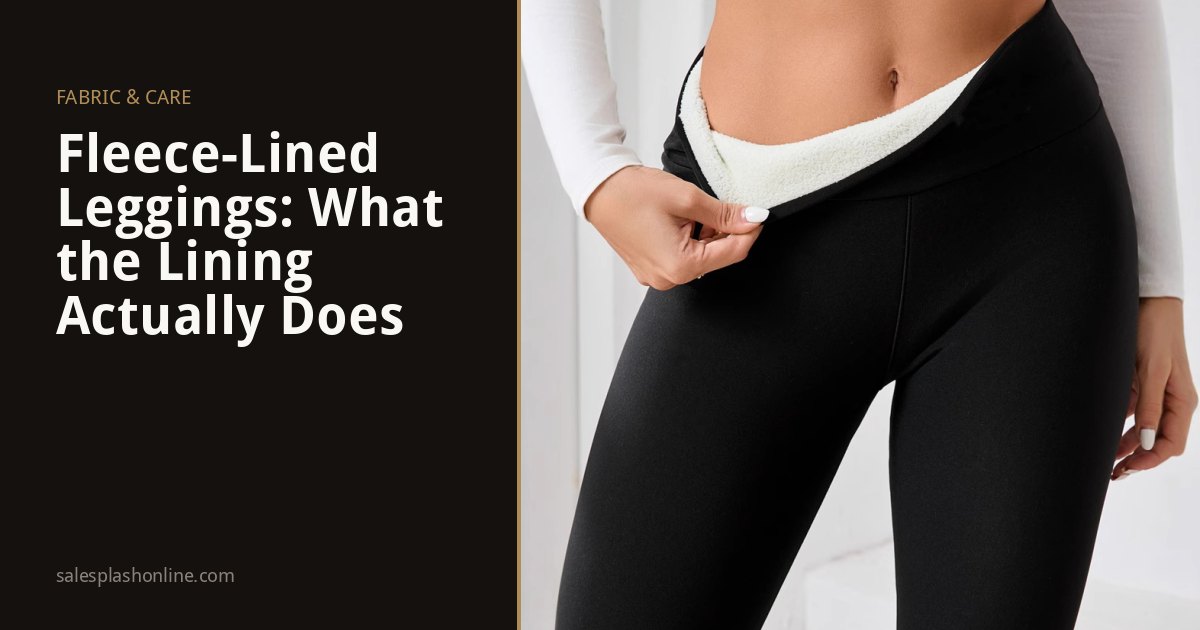
Fleece-lined leggings tend to get bought in a cold snap, worn twice, and then quietly retired because they turned out to be the wrong weight or the wrong size. Nearly all of that is avoidable. Here is what the lining actually is, what it does to the fit, and how to keep it working.
“Fleece-lined” does not mean fleece
The lining in almost every fleece-lined legging is not the fleece you would find in a zip-up jacket. It is a brushed knit: the inside face of the fabric is mechanically raised so fine fibres stand up off the surface. Those raised fibres trap a thin layer of still air against the skin, and the trapped air is what keeps you warm. The fabric itself is not especially insulating — the air it holds is.
You will see it sold as velvet-fleece, brushed fleece or thermal lining. Those are the same idea at different densities. What actually changes between them is how long and how dense the raised pile is, which is why weight tells you more than the name does.
Weight grades are the number worth reading
Winter leggings are commonly graded by fabric weight in grams per square metre. Across the styles we stock, that falls into roughly three tiers:
- Around 80g, unlined — a standard legging weight. Fine under trousers or for an autumn walk, not a cold-weather layer on its own.
- Around 200g — a genuine winter weight with a short brushed pile. Warm under a coat, still thin enough to wear under jeans.
- Around 300g — a thick pile. Noticeably bulkier, the warmest of the three, and the one that will feel too hot indoors.
Most people over-buy here. If you are mainly going between a car and a building, 200g is usually the right call. The 300g weights earn their keep only if you are outside for long stretches.
The lining takes up room, so size for it
This is the most common sizing mistake with winter leggings. The brushed pile occupies real space inside the leg — a 200g lining can take up several millimetres all the way round, before the fabric has to stretch over you at all. A fleece-lined legging in your usual size will fit tighter than an unlined one in the same size.
Two consequences. If you are between sizes, take the larger one on lined styles even where you would take the smaller on a plain knit. And remember our sizing is international and already runs about one size smaller than US sizing: our XXL sits at roughly a US XL (16–18), XXXL at around a US XXL (20–22). Measure against the size guide rather than ordering by the letter on the label.
The one thing lining is genuinely good at
Opacity. A single-layer knit gets thinner as it stretches, which is why plain leggings can go sheer across the seat at larger sizes. A brushed lining puts a second structure behind the face fabric, so lined winter styles are almost always more opaque than their unlined equivalents. If see-through leggings have been a problem for you, a lined pair fixes it far more reliably than simply buying a darker colour. Our squat test takes ten seconds and settles it either way.
What lining costs you
Being straight about the trade-off: lining costs you stretch and it costs you breathability. The raised pile restricts how far the knit can extend and how quickly it returns, so lined leggings feel less springy than a seamless gym legging and recover more slowly over a long day. They are also warm by design, which makes them a poor choice for training indoors — you will overheat. For the gym, an unlined seamless or compression style is the better tool for the job.
Washing them without ruining the pile
Almost all fleece-lining damage is laundry damage, and it accumulates rather than happening all at once.
- Turn them inside out. The pile is on the inside, and washing it against other garments is what mats it.
- Cold wash, gentle cycle. Heat relaxes elastane and flattens brushed fibres permanently.
- No fabric softener. It coats the raised fibres and makes them clump — softer for one wear, matted after that.
- Air dry. A tumble dryer is the fastest way to destroy both the elastane and the pile. Hang them rather than draping them over a radiator, which does the same thing more slowly.
The full washing guide covers the same ground for unlined styles.
What we stock
Four lined styles, deliberately spanning different weights and cuts:
- Fleece-Lined Winter Leggings — velvet-fleece lined, high waist, plain or embroidered, S to XXL.
- Fleece-Lined High-Waist Leggings — the same idea over a longer size run, S through 3XL, at one price for every size.
- Fleece-Lined Skirted Leggings — an attached skirt panel over the legging, offered with and without lining, M to 4XL.
- Thermal Culotte Leggings — a fleece-lined legging under a culotte-style overlay, M to 4XL.
The last two run to 4XL, which is the deeper end of what we carry; most of the range stops at XXL. If you are choosing between those two, our guide to skirted and culotte leggings explains how the overlays differ. If you are shopping the larger sizes specifically, the plus size page lists only styles where the bigger sizes genuinely exist.
Browse the full leggings range, or read the fabric guide for how nylon, polyester and cotton blends compare before you choose.
Shop this guide: fleece-lined leggings · high-waisted leggings · black leggings