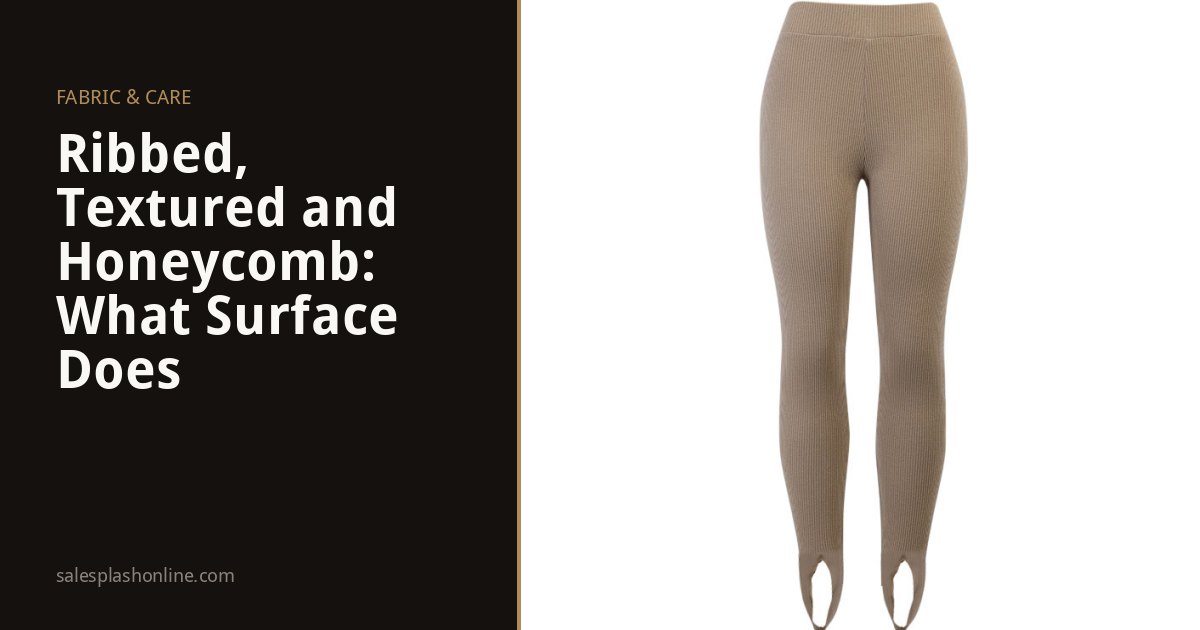
Ribbed, honeycomb, waffle, jacquard, bubble — textured leggings are usually sold on how they look, and the texture is treated as decoration. It is not. Surface texture in a knitted garment is structural, it is knitted in rather than applied, and it changes how the fabric performs in four measurable ways.
Texture is built, not printed
The first thing worth understanding is that these surfaces are not embossed or pressed onto finished fabric. They are produced by the knitting itself — by varying stitch types, stitch tension and needle selection as the fabric is formed.
That matters practically: a knitted texture cannot wear off, crack, peel or fade in the way a printed or heat-pressed finish can. It is the same fibre all the way through. The texture will still be there after a hundred washes.
The main families you will encounter:
- Ribbed. Alternating columns of front and back stitches, producing vertical channels. The oldest and simplest structure.
- Honeycomb and waffle. A cellular structure created by held stitches, giving a raised grid with recessed pockets.
- Jacquard. Patterns knitted by selecting individual needles, so the design is genuinely part of the fabric structure rather than a surface effect.
- Bubble and blister. Two layers knitted together at intervals, so the face fabric puffs between the join points.
What texture actually does, in order of importance
1. It improves opacity. This is the most useful and least advertised benefit. Textured structures put more yarn into the same area of fabric, and the varied surface scatters light rather than letting it pass straight through. A honeycomb or jacquard knit of a given weight will hold its opacity further into its stretch range than a smooth knit of the same weight. If sheerness has been a problem, texture is one of the more reliable answers.
2. It adds recovery and structure. Ribbed structures in particular have mechanical stretch from the knit geometry itself, on top of the elastane. That means more stretch and better return to shape, which is why ribbed waistbands are near-universal.
3. It changes airflow. A raised surface holds the fabric slightly off the skin across part of its area, creating small air channels. In practice a textured knit feels less clammy than a flat one of similar weight, though this is a modest effect and not a substitute for genuine ventilation.
4. It disguises. A varied surface does not show creases, pressure marks or the outline of what is underneath the way a flat matte knit does. This is why textured styles photograph forgivingly.
The trade-offs, honestly
Texture is not free, and the costs are real.
- Weight. More yarn in the same area means a heavier garment. Textured leggings are warmer, which is welcome in autumn and unwelcome in July.
- Snagging. Raised surfaces catch on velcro, jewellery, rough seating and pet claws. A pulled loop in a knitted texture is visible and cannot be repaired invisibly.
- Drying time. A raised structure holds more water in its recesses than a flat knit, so it takes longer to dry. This is why heavily textured styles are a poor choice for hot-weather running.
- Cost. Textured knitting is slower and needs more capable machinery, so these styles generally sit higher in a range.
Which texture for what
- Ribbed — everyday wear and cooler weather. Excellent recovery, forgiving of sizing, reads as clothing rather than gym kit, which makes it one of the better crossover options.
- Honeycomb and waffle — training. Good opacity, some airflow, and enough surface to disguise sweat patches better than a flat knit.
- Jacquard — the dressiest of the four. Because the pattern is knitted in, it has depth and reads as a designed fabric, which is why jacquard styles work outside the gym.
- Bubble and blister — light insulation. The trapped air between layers gives some warmth for very little weight.
A note on “scrunch” seams, which are not texture
Worth separating, because they are often grouped together. A gathered or ruched centre-back seam is a construction detail — a seam sewn or knitted to draw fabric together at the centre back. It is not a fabric texture, it does not change opacity or breathability, and it behaves differently in the wash. It is a design feature, and a fairly common one across our range.
Caring for a textured knit
The rules are the same as any performance knit, with one addition that matters more here.
- Turn inside out and wash cold. This protects the raised face from abrasion, which is what flattens texture over time.
- Wash separately from anything with hooks, zips or velcro. This is the addition. A single zip in the same load is the most common cause of a pulled loop.
- No fabric softener. It coats the fibres and fills the recesses, dulling both the texture and any wicking behaviour.
- Air dry, and give it longer. Textured knits genuinely take longer than flat ones. Do not compensate with a tumble dryer, which flattens the structure permanently.
The washing guide covers the rest.
What we stock
- Honeycomb Textured High-Waist Leggings and Honeycomb High-Waist Yoga Leggings — in black, grey or blue.
- Jacquard Seamless Leggings (extended size range) and Jacquard Seamless High-Waist Leggings — woven-in texture pattern.
- Textured High-Waist Gym Leggings — five deep solid colours, breathable.
- Quick-Dry Textured Gym Leggings — bubble texture in a fast-drying knit, the best textured option for warm weather.
- Seamless Scrunch-Back Gym Leggings — a ribbed seamless knit cut for training and everyday wear.
- Ribbed High-Waist Gym Shorts — ribbed knit in eight colours.
The fabric guide covers the fibres themselves, and this piece explains how seamless knitting produces these structures without side seams. Browse the leggings range.