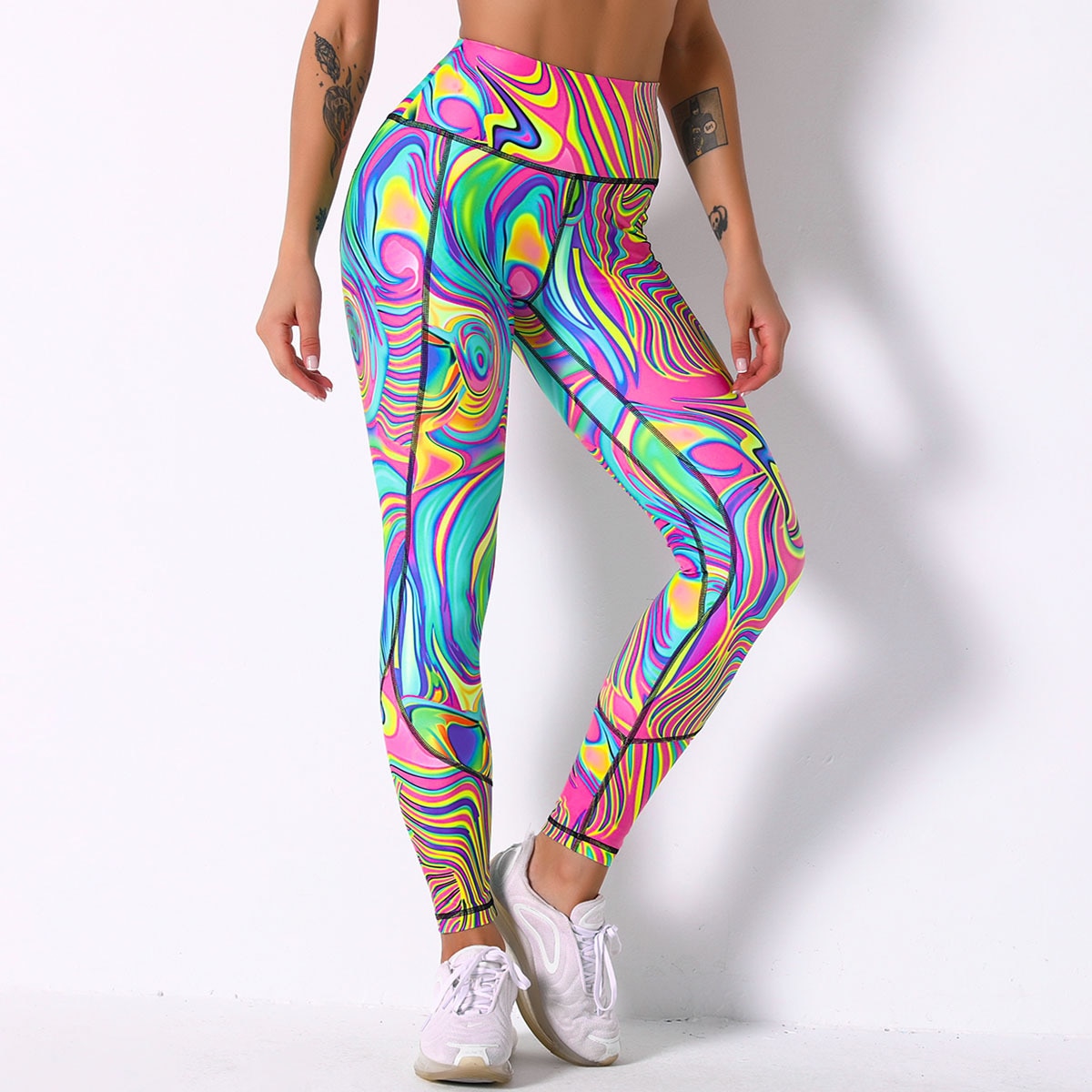
Flame prints, tie-dye, camouflage, leopard, watercolour swirls — printed leggings are usually bought on the pattern alone, and the way the pattern got there is rarely mentioned. It is worth knowing, because it decides how the leggings look once they are stretched over a body, how they wash, and how long the colour lasts. There are broadly three ways a pattern ends up on a legging, and they behave differently.
Knitted in: the pattern is the fabric
On seamless leggings the pattern is usually produced by the knitting machine itself, by feeding different coloured yarns as the tube of fabric is formed. The colour is not sitting on top of the fabric; it is the fabric. Our guide to what seamless actually means covers the construction in more detail, but the practical consequences for a printed style are these:
- It cannot crack or peel. There is no surface layer to wear away. The pattern will look the same after a year of washing as it does on day one, give or take the gradual fading every dyed yarn goes through.
- It stretches with you. Because the colour runs through the yarn, the pattern simply gets larger where the fabric is stretched most. It does not go pale.
- The designs are softer-edged. Knitting works in stitches, a little like pixels, so knitted-in patterns tend towards bold shapes, stripes, swirls and marbled effects rather than fine photographic detail.
Three of our styles are made this way. The Women’s Printed Seamless Leggings ($23, S to XL) come in ten all-over designs, including a black-and-white tie-dye, a pastel rainbow swirl and a white snake print. The Flame-Print Seamless High-Waist Leggings ($22, S to L) carry a blue flame pattern on a seamless base. And the Tie-Dye Seamless Yoga Leggings ($23, S to L) use a tie-dye colour wash in black, blue, pink or yellow.
Printed on: sharper detail, different weak points
Cut-and-sew leggings are made from flat fabric, and a flat fabric can be printed before it is cut. Digital printing puts down fine detail that knitting cannot: realistic animal prints, small-scale camouflage, gradients and anything that relies on crisp edges.
The trade-off is that the colour sits mainly in the surface of the fabric rather than running all the way through the yarn. On a garment designed to stretch, that has one visible consequence. Where the fabric is pulled hardest — the knee when you crouch, the seat when you bend — the knit opens up and you see more of the base yarn between the printed areas. On some printed fabrics that shows as a paler patch at the stretch points. It is not a fault so much as a property of printed stretch fabric, and the way to check for it is the same bend-and-look test we describe in our squat-proof test: put them on, squat in front of a mirror, and look at both the opacity and the colour at the seat.
Our printed-on styles include the Camouflage Print Workout Leggings ($17, S to XL, purple), the Leopard and Zebra Print Gym Leggings ($25, S to L, with a scrunch back seam), the Slim-Fit Printed Stretch Leggings ($18, S to XL) and the Digital-Print Compression Yoga Leggings ($17, S to XL). That last pair is a compression knit, so it is meant to feel firmer than a standard legging; if you have not worn compression before, our note on how compression wear should fit explains what snug-but-not-restrictive actually feels like.
Tie-dye: a look, not a method
“Tie-dye” on activewear almost always describes the appearance, not a process. Traditional tie-dye means binding finished fabric and dipping it by hand, which produces a unique pattern every time. Mass-made tie-dye leggings get the same marbled effect through a colour wash, a knitted-in pattern or a print, and the pattern is repeated from pair to pair.
That is not a criticism, just a reason to set expectations: you are buying a tie-dye look, made consistently. Besides the two seamless styles above, the Tie-Dye High-Waist Leggings ($18, S to XL) are a cut-and-sew pair in a polyester and spandex blend, in yellow, blush pink or red.
Bright dyed colours are the ones most likely to bleed in the first few washes. Wash tie-dye pairs with similar colours, or on their own the first time, in cold water.
What a print does and does not hide
A busy pattern is genuinely practical in one respect: it breaks up the surface, so sweat marks, lint and small creases are far less visible than on a plain black or grey legging. That is a real reason to choose a print for long sessions or hot days.
What a print does not do is make thin fabric thicker. A pattern can distract the eye from slight sheerness in a photograph, but in harsh gym lighting a thin knit is still a thin knit. Opacity comes from fabric weight, knit density and how far the fabric is being stretched — which is why sizing matters so much. Our article on why leggings go sheer at larger sizes explains the mechanism, and it applies to printed pairs exactly as it does to plain ones.
Sizing: the honest picture
This is where printed leggings are most limited, and it is better to say so plainly. Most of our printed styles stop at XL, and three — the flame print, the tie-dye seamless pair and the leopard and zebra print — stop at L. All of them are cut to Asian sizing, which runs about one size smaller than US sizing, so an XL fits roughly like a US L and an L like a US M.
The one printed style that goes further is the Printed High-Waist Tummy-Control Leggings ($19, S to 2XL, roughly US XS to XL), which has a wide, firm waistband that smooths through the midsection and comes in white, black-and-white or multicolour. If you need a size above that, our printed range will not fit you, and it is better to know that before ordering than after. Our plus-size leggings page lists the styles that do go up to 3XL and 4XL; they are mostly solid colours.
Whatever you choose, check your hip and waist measurements against the size guide rather than going by your usual size. If you are between two sizes on a printed style, size up: a print that is over-stretched is the one most likely to look washed out at the seat.
Looking after printed leggings
The general rules in our guide to washing leggings apply, with a few that matter more for prints:
- Turn them inside out. This reduces rubbing against zips and other garments in the drum, which is what dulls a surface print over time.
- Wash cold, with like colours. Heat speeds up fading and is hard on elastane.
- Never iron the print, and skip the tumble dryer. Hang them to dry.
- Leave out fabric softener. It coats the fibres and works against the stretch.
Treated that way, a knitted-in pattern will last as long as the leggings do, and a good surface print will last most of that time. If you want to browse the full range, every printed and plain style is on our leggings page.